
Posted On April 2, 2026
Let’s be honest: when your employees can clock in from the parking lot across the street—or worse, from a coffee shop ten minutes away—your attendance data stops meaning much. Geo-fencing fixes that. Quietly. Automatically.
Here’s a scenario I’ve seen play out more times than I’d like to admit: your attendance reports say 95% of your team showed up on time, but somehow productivity is still a mess. Managers are running around trying to figure out who’s actually working. Projects keep slipping. You start wondering if those nice clean numbers are even real.
That gap between what your system says and what’s actually happening on the ground? It’s way more common than most HR leaders want to talk about. Old-school attendance tools—swipe cards, sign-in sheets, even fancy biometrics—all share the same blind spot. A good geo-fencing HRMS changes that completely.
So what does geo-fencing actually do?
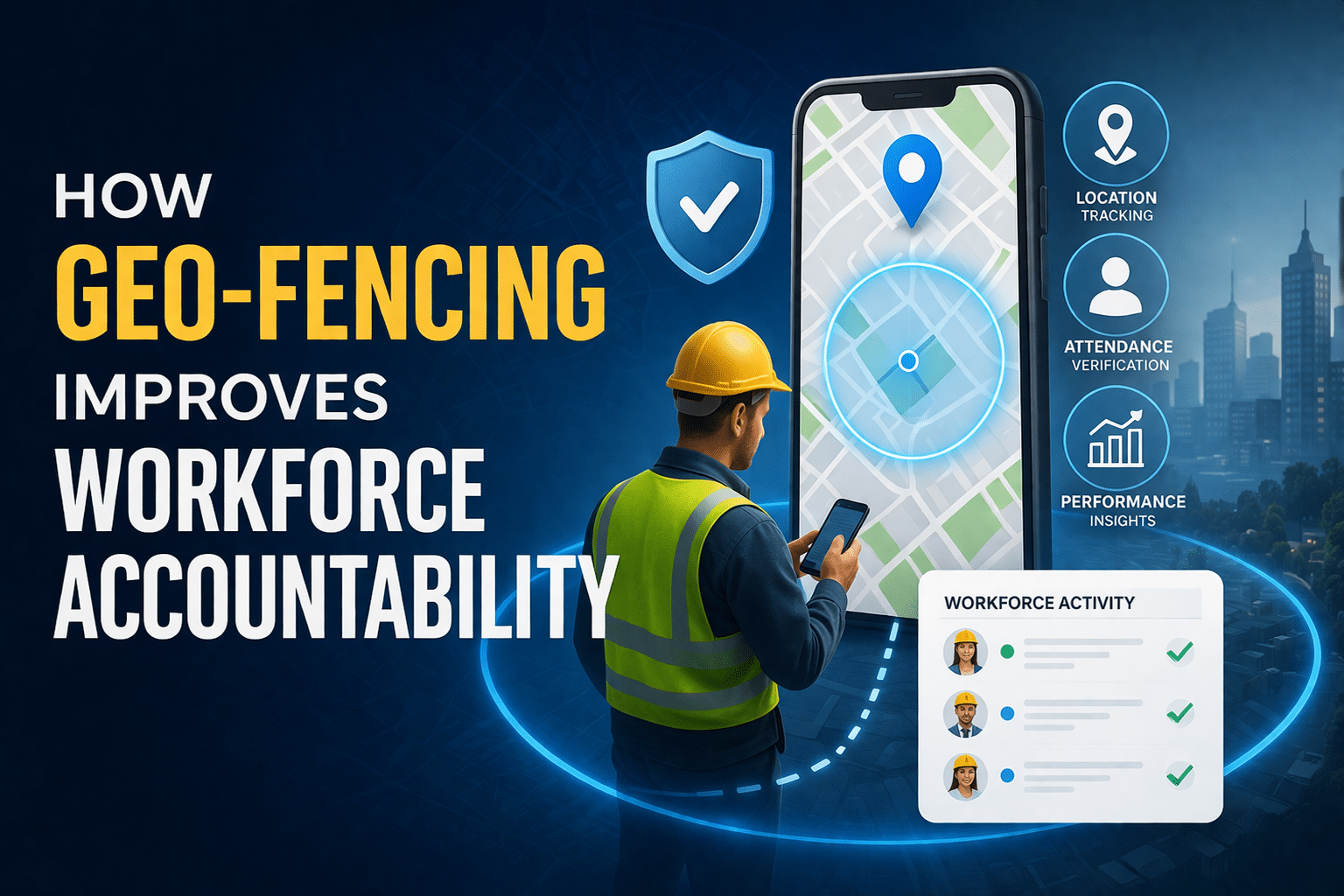
In plain English: geo-fencing uses GPS to draw a virtual fence around a real-world location. Think of a factory floor, a construction site, a client’s office. The second an employee’s phone crosses into that boundary, the system logs an attendance event. No tapping buttons. No fudging the truth.
When that’s built into an employee tracking platform, the data flows straight into payroll, compliance records, and workforce analytics.
-
34%
average drop in time theft after switching to GPS attendance -
2.3×
faster payroll processing thanks to automated location logs -
91%
of field managers say they finally have clear workforce visibility

Why old-school attendance systems just don’t cut it anymore
Most traditional attendance systems run on trust. They assume that if someone logged in, they must be physically there. That assumption gets harder to defend every day—especially with remote work, field teams scattered everywhere, and hybrid setups that change week to week.
Then there’s buddy punching. It costs companies about 2.2% of their total payroll every year. A GPS-based attendance system doesn’t leave room for those workarounds. The record is tied to a device’s real-world location, stamped with the time, and locked in.
How GPS attendance builds accountability (without being a jerk about it)
Workforce accountability isn’t about catching people doing something wrong. It’s about making expectations clear, keeping records accurate, and building trust on real information.
1. Check-ins you can actually trust
When someone checks in, you know they’re actually there. Not “in the vicinity.” Not “I swear I was on site.” Actually there.
2. Alerts when someone leaves early—or goes somewhere they shouldn’t
If someone leaves the worksite before their shift ends, the system can flag that in real time. The supervisor gets a notification. And just that awareness tends to improve compliance on its own.
3. No more fighting over overtime and pay
Because entry and exit times get captured automatically—and tied to a physical location—disputes over hours worked become a lot easier to resolve.
4. Managing multiple sites without losing your mind
If your people work across different locations, you can set up separate geo-fences for each site. The system knows exactly which location someone was at, how long they were there, and whether it matches their scheduled assignment.
- Kills buddy punching and proxy attendance fraud
- Gives you real-time location validation for field and remote teams
- Drives down payroll errors from manual entry
- Creates a clean audit trail for compliance and disputes
- Links shift scheduling with location-based check-in rules
- Handles multi-site workforces with custom zones for each location

A quick word on doing this the right way
If you roll out geo-fencing without telling anyone first, you’re going to have a bad time. Employees need to know what’s being collected, why, and who can see it. Most modern systems let you limit data collection to working hours only — personal movements outside of shifts stay completely private.
What to look for in a geo-fencing HRMS
Look for platforms that let you adjust the fence radius — a 50-metre zone for a downtown office works very differently from a 500-metre zone for a huge industrial site. The system should also handle GPS drift gracefully, so a legit check-in doesn’t get rejected because a phone’s location hiccupped for a second.
Integration with payroll and leave management matters enormously. A location-verified attendance record is only as valuable as what happens to it downstream.

The bottom line
Workforce accountability has always mattered. But the tools we’ve had to support it have lagged behind the complexity of modern work arrangements. Geo-fencing — when properly built into an employee tracking platform — closes that gap without adding administrative hell or turning your workplace into a surveillance state.
The result is attendance data you can actually rely on. Payroll calculations that hold up when someone asks questions. And a workforce that knows the rules are clear, consistent, and apply to everyone the same way.
Recent Posts

Comparison of Top Travel Back-Office Platforms
Read Post
Flight Refunds & Rebookings Made Simple: A Practical Guide for Travel Agents
Read Post
SEO Trends 2026: Challenges & strategies that work
Read Post
How to Implement a Travel CRM for Your Business
Read Post