Posted On April 4, 2026
Customer satisfaction, efficiency, and real-time communication are non-negotiable in the competitive travel industry. If you are a travel agency, a tourist company or tour operator, a Destination Management Company (DMC), or a Travel Management Company (TMC), Travel CRM will improve your business processes and relationships with clients.
However, it is important to think through and implement it strategically to make it successful. This is a step-by-step guide to implementing a travel CRM in your business.
What is travel CRM?
Travel CRM is a system used to help travel companies organize and schedule their travel process in a single platform. In addition to managing people and destinations, business travel CRM software offers essential insights into customer behavior, booking history, and preferences — allowing an agency to make the right decisions.
Travel CRM will help bridge and schedule your itineraries, where you will find certain places of interest, and how and where to find details of your clients’ profiles and travels.

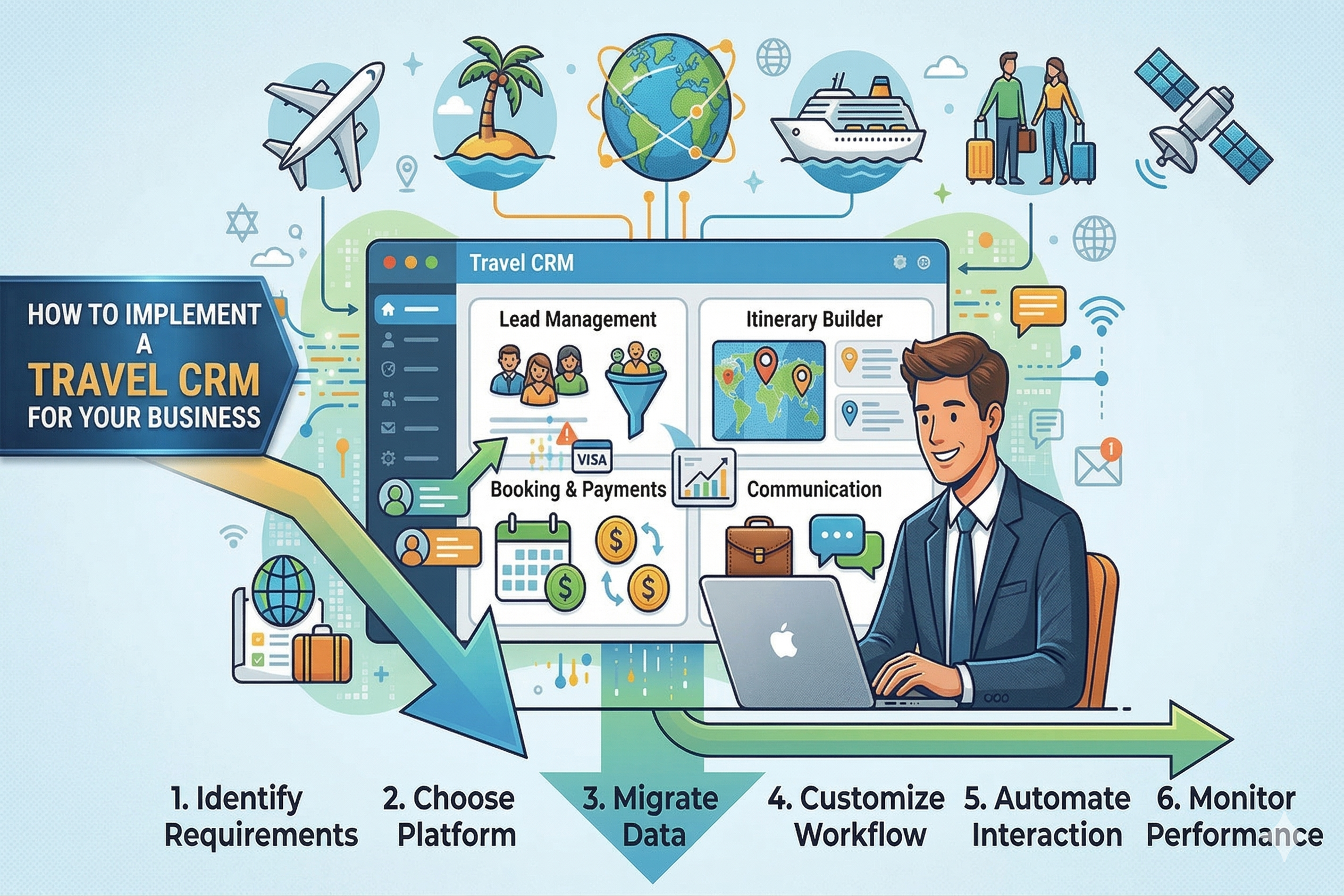
Step-by-step process to implement a travel CRM for your business
This is a step-by-step plan for applying a travel CRM to your agency, tour company, DMC, or TMC.
Learn business requirements
Identify your travel company’s specific needs before selecting a CRM. A typical travel business has multifaceted customer interactions — requests, reservations, follow-ups, payments, itineraries, and post-travel reviews.
Questions to ask:
- Do you deal with B2B, B2C, or both?
- Is lead management, automation, itinerary planning, or supplier management important to you?
- What channels do your customers use — social media, email, web forms?
Learning about these requirements will help you choose a CRM with custom functions that track leads, manage trips, handle invoicing, communicate with suppliers, and offer analytics.
Selection of the appropriate travel CRM platform
The list of CRM solutions on the market is large, but most are unsuitable for the travel industry. Choose a platform that is travel-specific or allows a high level of customization for travel processes. The optimal travel CRM should facilitate:
- Itinerary construction
- Lead and opportunity tracking
- GDS connectivity and booking engine integration
- Multi-channel communication — email, SMS, WhatsApp
Gear up data migration and integration
One of the most important aspects of CRM implementation is migrating current customer information into the new system. Ensure your team cleans, classifies, and verifies data before migration. Select a CRM that can easily integrate with other systems — accounting, marketing, booking software, or travel APIs.
This creates an integrated landscape with reduced redundancy and hassle-free workflows.

Customize the CRM to fit your workflow
Each business in the travel industry is different. It is very important to make the CRM fit your particular processes. Common areas of customization include:
- Lead steps: Inquiry → Quotation Sent → Follow-up → Booked → Travel Completed
- Automated tasks: Automatic alerts on visa expiry, payment balances, or travel dates
- Role-based access: Sales team, operations, finance, and management each get a separate dashboard
- Templates: Itinerary, invoice, and email templates ready to use
Automate and streamline customer interactions
With the help of CRM, travel enterprises can delegate routine tasks efficiently. Email automation sends booking confirmations, reminders, travel documents, and promotional messages. Personalized communication through CRM saves time and keeps customers informed with relevant, timely information — improving satisfaction significantly.
Monitor performance and optimize
After implementation, it is crucial to monitor the performance of the CRM. Is response time getting better? Are leads being converted? Track these key KPIs:
- Conversion rate
- Mean response time
- Booking value per client
- Agent productivity

Conclusion
Implementing a travel CRM is not merely the installation of new software. Whether streamlining inquiries or personalizing travel experiences, an effective CRM allows travel agencies, DMCs, and TMCs to remain on top of a customer-led environment. With the correct system, proper data preparation, workflow customization, and team training, your company unlocks the full potential of CRM and establishes long-term growth.
Manage every client relationship with yCRM
yCRM by Yiron Technologies is a travel-specific CRM built for agencies, tour operators, DMCs, and TMCs — combining lead management, itinerary tracking, automated follow-ups, and real-time reporting in one platform.
Recent Posts

Comparison of Top Travel Back-Office Platforms
Read Post
Flight Refunds & Rebookings Made Simple: A Practical Guide for Travel Agents
Read Post
SEO Trends 2026: Challenges & strategies that work
Read Post
How to Implement a Travel CRM for Your Business
Read Post